

California Abortion Pill Reversal Case: Opening Statement for the Defense
Delivered by Paul M. Jonna in The People of the State of California v. Heartbeat International & RealOptions.
The following is a reproduction of the Defense's opening statement delivered by Paul M. Jonna—Special Counsel for Thomas More Society and Partner at LiMandri & Jonna LLP—on June 24, 2026, in The People of the State of California v. Heartbeat International & RealOptions.
I. Introduction
Your Honor, we just heard counsel describe consumer fraud. Counsel used words like “advertising,” “selling,” “consumers,” “deception.” The evidence will not match those descriptions.
Counsel told you this case is about false advertising. The evidence will show it is about information—true information, given for free, to women who asked for it, about a safe, effective, and legal way to help them try to continue a pregnancy after they have taken the abortion pill.
She told you these are commercial enterprises. The evidence will show two religious charities: one that doesn’t provide Abortion Pill Reversal at all, and one that provides it for free.
And the Court will see what the Attorney General seeks to do about that information. He’s asking this Court to impose more than $20 million in penalties on these two charities for providing this information.
Here’s the one inconvenient fact for the Attorney General that frames everything the Court will hear in this trial. The Attorney General investigated these Defendants, then took years of discovery. And after all of it, he has not produced a single complaint from a single patient.
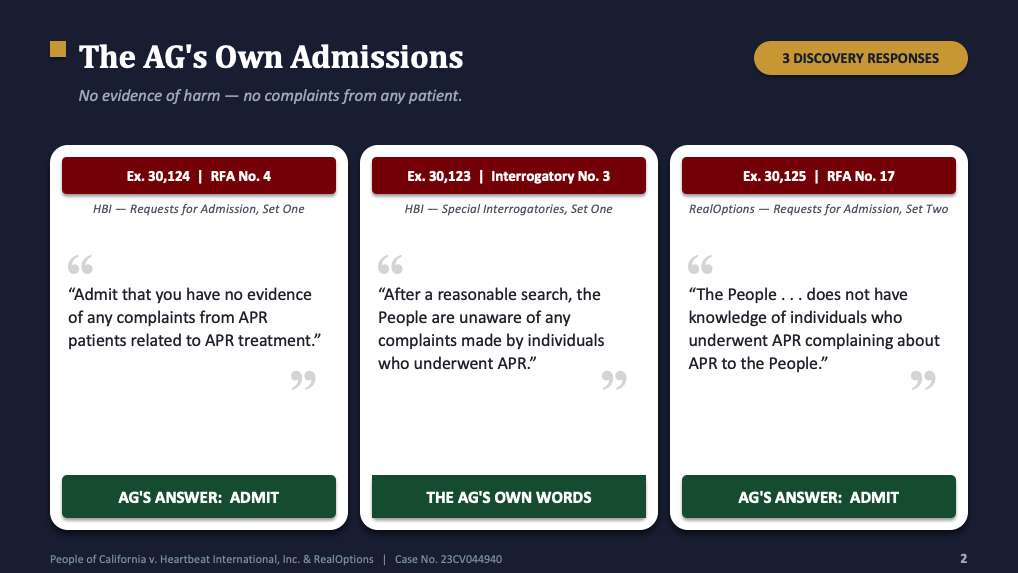
These verified discovery responses [Slide 2] show the Attorney General admitting that he knows of not one woman harmed from APR. Not one woman deceived. The Court will hear that absence—the absence of any victim—again and again, because it runs through every issue in this case.
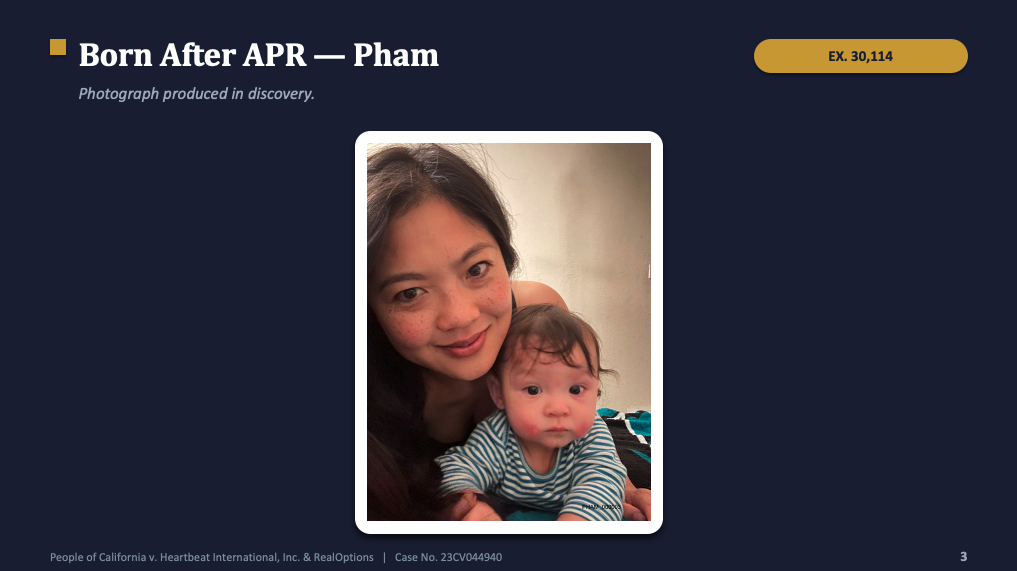
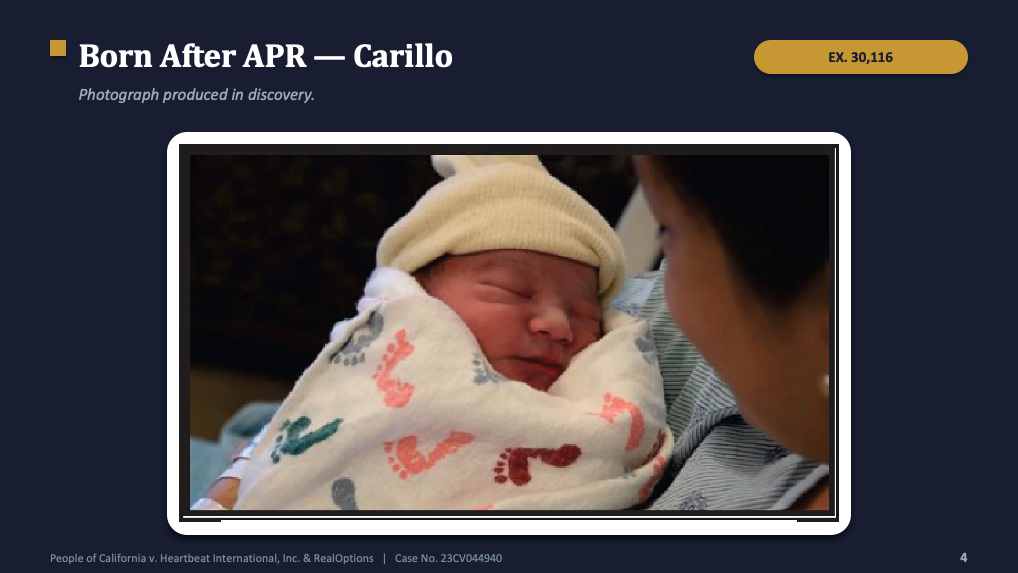
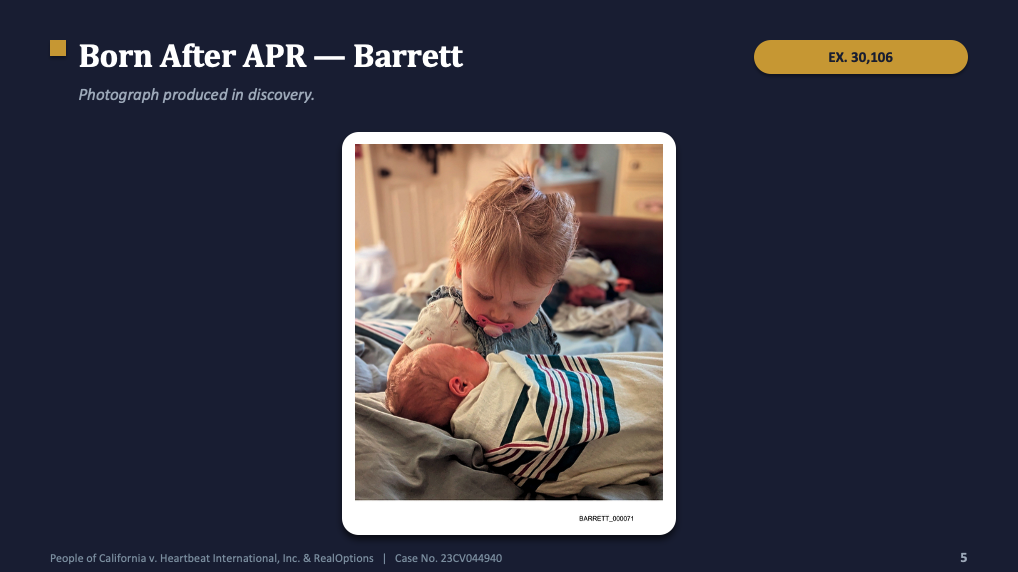
What the record contains, instead, is testimony from Defendants’ witnesses—women the State has now put on its witness list: Uyen Pham, Erika Carrillo, Elizabeth Barrett, and others—mothers who sought out APR and have living children today. Slide 3 shows Uyen Pham holding the healthy baby she carried to term after APR. Slide 4 shows Erika Carrillo’s child. Slide 5 shows Elizabeth Barrett’s. The Court will hear how grateful they are to have had a second chance—and to choose life for their baby—because they had truthful information about APR when they needed it most. And our clients could have filled this trial with countless other such stories, because there are thousands.
As far as the legal framework: Your Honor can rule for Defendants on any one of several independent grounds.
First, the threshold question of commercial speech. The False Advertising Law (FAL) reaches only commercial speech—and the Attorney General acknowledges that. The evidence will show this speech is not commercial. That alone ends the case.
Second, the burden of proof. Even if this were commercial speech, the burden is the Attorney General’s to prove these statements false—and the evidence he puts on will be criticism of our science, not proof that any statement is untrue.
Third, the merits. The evidence will show the statements are accurate, or at minimum that Defendants reasonably relied on legitimate science—which independently defeats the claim.
And fourth, the constitutional defenses. Even past all of that, the evidence will establish that this speech is protected—by free speech, free exercise, and the right to reproductive privacy.
Each of those is a complete defense. The Court need only reach one to find in favor of Defendants.
II. Who the Defendants Are
Before I go further, the Court should know who these two Defendants are, because they are different organizations and the difference matters. Heartbeat International—its homepage shown in Slide 6—is a nonprofit charity with roots going back more than fifty years. It was founded in 1971, before Roe v. Wade, by an obstetrician and a refugee who had fled Nazi Germany. They began with something simple: a network of hotlines and pregnancy help services for women facing unplanned pregnancies. The original name was “Alternatives to Abortion,” and that phrase captures the organization’s purpose to this day. In 1993 it took the name Heartbeat International.

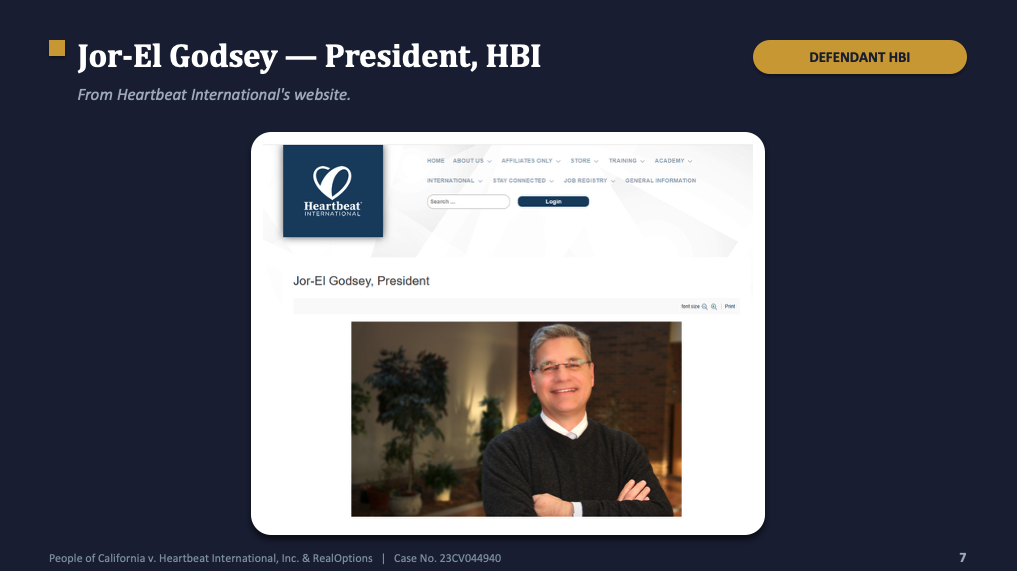
The Court will hear this from Jor-El Godsey, shown in Slide 7, Heartbeat International’s president. Mr. Godsey will explain that Heartbeat International is a Christian 501(c)(3) based in Columbus, Ohio, with employees who share its religious mission, and that it operates the Abortion Pill Reversal Network—a listing of roughly 1,400 providers nationwide, about 90 of them in California—which Heartbeat International acquired from Dr. Delgado in 2018 for one dollar.
The evidence will show that Heartbeat International took over the APR Network about two years after the California nursing board audited Heartbeat International’s continuing education courses on APR and approved them—concluding they were based on generally accepted scientific principles.
The Court will hear from Mr. Godsey and Christa Brown that Heartbeat International does not itself provide Abortion Pill Reversal. It provides information and connects women who ask for help with volunteer providers. It takes no kickback on a referral. Christa Brown, shown in Slide 8, runs the APR Network’s operations and will describe the intake, the disclosures, and the absence of any financial incentive tied to a referral.

As far as why Heartbeat International doesn’t refer women to abortion providers for APR: we will show that because time is of the essence for these women, they need providers familiar with APR, and abortion providers don’t offer APR.
RealOptions is a different kind of organization. Their website homepage is shown in Slide 9. The Court will hear from Tasha Keirns, Valerie Hill, and Donne Hecke, shown in Slide 10. They will describe a nonprofit operating state-licensed community clinics right here in the Bay Area: two in San Jose, one in Oakland, and one in Union City. Its clinics are licensed by the California Department of Public Health, and it provides a wide array of clinical care for obstetrics, gynecology, and sexual health. They serve patients with or without insurance. APR is one service among many. And the evidence will show RealOptions receives no payment for the reversal care it provides; the care is free. The evidence will show that a substantial percentage of RealOptions’ patients are below the poverty line and receive completely free health care.


RealOptions’ own standard is printed on its materials in four words: “We inform; you decide.” That’s the posture of a licensed clinic giving patients information and letting them make their own choice.
So the evidence will show that neither Defendant profits from APR. One doesn’t provide it at all; the other provides it for free. This is important because the State’s entire theory depends on calling this a commercial enterprise. It is not.
III. The Threshold Question: Is This Commercial Speech? No.
The Court should start and end with the threshold question of commercial speech, without having to read studies and weigh the science, because both sides agree the FAL and Unfair Competition Law (UCL) reach only commercial speech. The U.S. Court of Appeals for the Second Circuit has already held in NIFLA v. James that APR speech that is materially identical to the speech challenged in this case is noncommercial. If that federal appeals court correctly understood the federal constitution, this case is over and the Attorney General must lose.
It cannot seriously be argued the Second Circuit got it wrong. Commercial speech, as the California Supreme Court instructs us, does no more than propose a commercial transaction. To test whether speech has such a narrow aim, California courts ask three things: whether the speaker is a commercial actor, whether the audience is a commercial audience, and whether the speech makes representations of a commercial nature. In close cases, courts also ask if economic motive is the primary driver of the speech.
The evidence will show Defendants’ challenged speech exhibits the exact opposite of each hallmark of commercial speech. Mr. Godsey and Ms. Keirns will describe how the religiously motivated nonprofit charities they run provide APR information, referrals, and services for free to individuals who contact them, to supporters, and to the public. Even if the Court looks at economic motive as a tiebreaker, the evidence will show there is no economic motive to provide APR. The evidence will instead show Defendants’ employees accept wages far below fair market rates to provide APR, no employee’s compensation is tied to APR metrics, and all donations connected to APR are reinvested in expanding APR offerings. It doesn’t matter if the 990s show $9 million or $90 million. We’ll explain how these groups operate and give the Court a clear picture of their program costs and expenses to understand how their charitable funds are used.
The Attorney General is asking the Court to ignore settled legal standards in favor of a new theory—that nonprofit fundraising somehow transmutes noncommercial speech into commercial speech, but only when the speech is coming from pro-life nonprofits. We will show that this provides yet additional evidence of viewpoint discrimination.
The Attorney General also tries to characterize APR as some kind of revenue driver with kits and trainings for sale and membership fees. The evidence will show that the kits are given away for free and any de minimis charges associated with the trainings and membership are meant to cover costs. None of these transform their charitable APR work into a commercial enterprise.
We will show that the evidence of Heartbeat International charging membership fees—like so many much larger nonprofits—does not make it a commercial speaker.
The Attorney General showed Joint Exhibits 26 and 29, where Heartbeat International and RealOptions tell women that they may have to pay for progesterone. That money does not go to either Heartbeat International or RealOptions; it goes to third-party pharmacies and therefore has no bearing on the commercial speech question. And the same documents actually state that Heartbeat International and RealOptions help subsidize that third-party cost in cases of financial hardship.
The Court will also hear that APR patients represent a fraction of one percent of RealOptions’ total patients. As I said, APR patients don’t pay, but the evidence will also show that almost none of RealOptions’ revenue comes from patients who do pay. Virtually all of their revenue comes from generous donors who help keep RealOptions’ doors open to serve this local community.
We will show that none of the APR statements at issue qualify as commercial speech.
IV. The Attorney General’s Burden
Your Honor, the second ground is the burden of proof—and it really does control how the Court should weigh every witness the State calls. That burden is the Attorney General’s, and it never shifts.
He cannot flip that burden and require Defendants to prove their statements true. At trial, the Attorney General, like any plaintiff, must prove that the challenged representations are actually false or misleading. He cannot prevail by calling Defendants’ claims “unsubstantiated”; he must prove falsity. That is the rule of King Bio and Mullins, and it binds public and private plaintiffs alike: neither may shift the burden to a defendant to substantiate its claims.
Here’s what the Attorney General’s evidence will actually consist of. It is criticism. His experts—Dr. Creinin and Dr. Glidden—will tell the Court they find Defendants’ studies unpersuasive: that the case series are too small, that they would have designed them differently, that they are not convinced. The Court should listen closely, because criticism of our evidence does not prove that our statements are false.
And on that score, the evidence will come up empty. The Attorney General cannot point the Court to a single study concluding that APR is unsafe or ineffective. The Court will hear the Attorney General’s own expert, Dr. Creinin, acknowledge that he does not have an opinion that APR does not work—and the Attorney General has admitted in discovery that he has no such study. Watch his experts for it. The study that proves falsity will not come.
Given that burden, the Defendants could rest their case on the testimony of the Attorney General’s own experts.
The State’s misinformation expert, Dr. Swire-Thompson, concedes the rest: she found no evidence that Defendants intended to deceive anyone, and she agrees that a statement that is true cannot be misinformation. Her opinion routes the Court back to the critical question—and the one the State cannot answer: are the statements actually false?
Dr. Creinin will be the first witness the Court hears. He will present his UC Davis study as a model of design and execution. The evidence will show otherwise. His trial was stopped early, after only twelve participants, leaving it far too small to prove anything. We will show that it departed from the blinding its own protocol required and claimed—Dr. Creinin privately called it “pseudo-blinded.” And the results were misreported—each time, in the direction that favored his view. The Court will see the receipts. The two women who actually suffered serious bleeding were both in the placebo group—the group that received no progesterone.
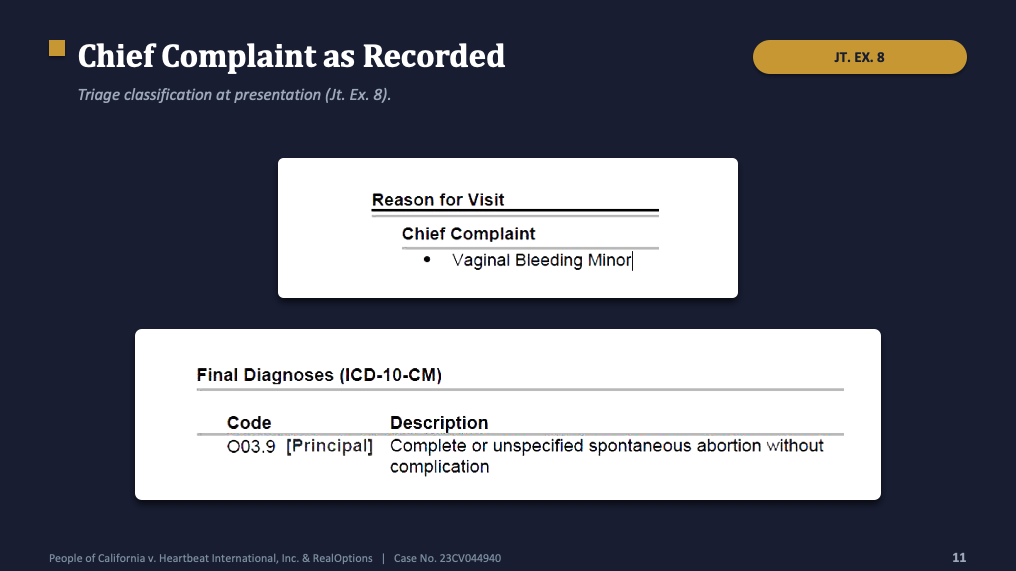
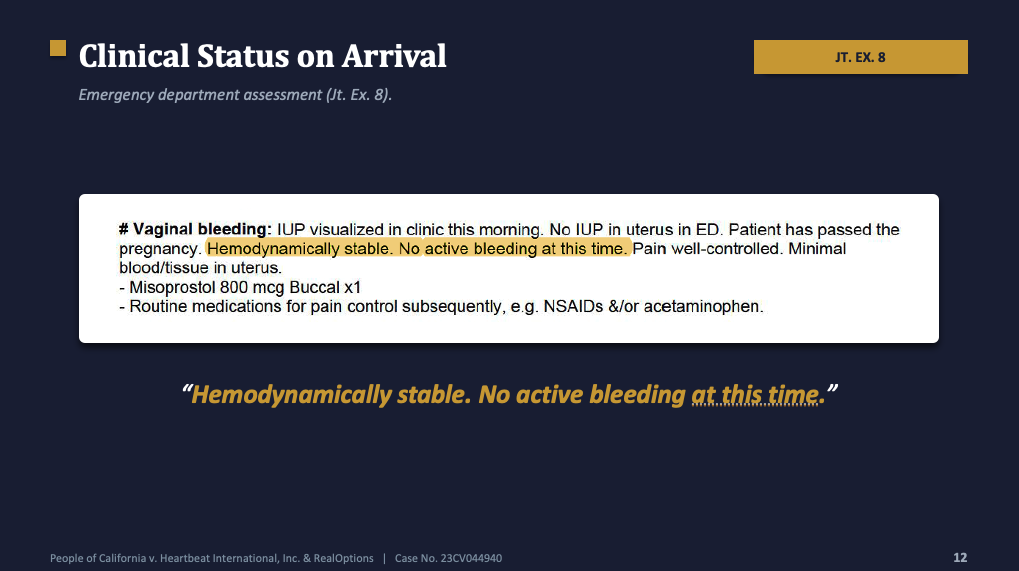
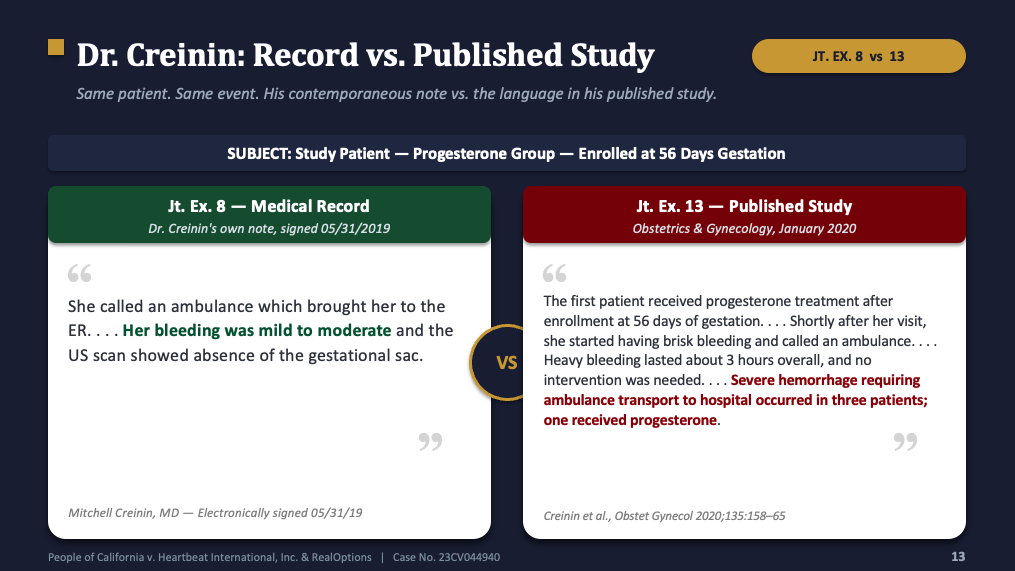
Dr. Creinin claimed that one woman in the progesterone group had a “severe hemorrhage”—Subject 8—but her medical records show zero evidence to support that claim. The evidence will show that she was diagnosed at intake with a complete abortion without complication—vaginal bleeding minor [Slide 11]. The hospital records confirm multiple times that her vitals were stable and that she had no active bleeding [Slide 12]. Dr. Creinin himself described her bleeding that day as only “mild to moderate” in the medical records [Slide 13], while claiming in the study she experienced a severe hemorrhage.
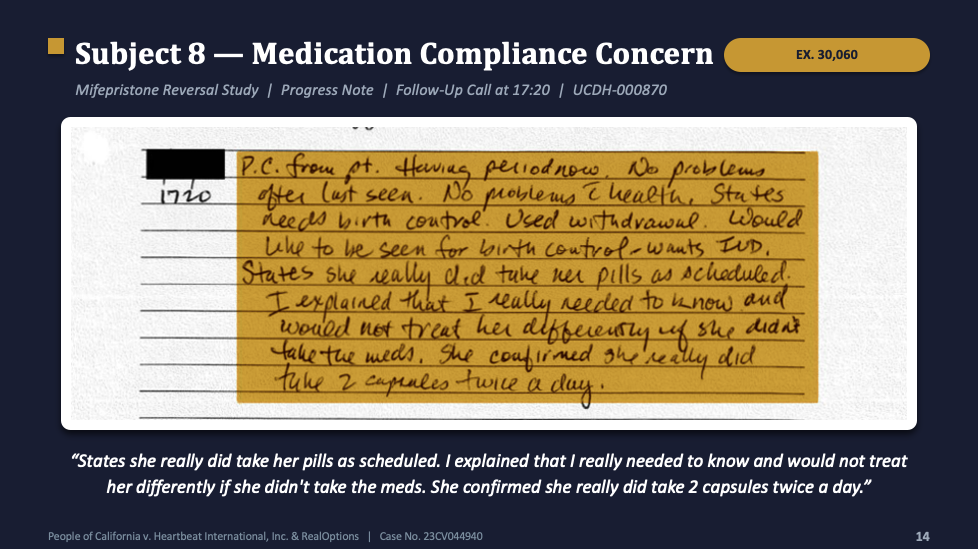
Subject 8’s treatment compliance was uncertain. Dr. Creinin will testify that, notwithstanding Subject 8’s anomalous progesterone results, he believes she took all of her progesterone pills. But the data will tell a different story. The charts will show that Subject 8’s progesterone levels remained relatively stable throughout the study, instead of rising as they would have with the administration of high-dose supplemental progesterone. And we know that Dr. Creinin suspected that Subject 8 did not actually take her progesterone pills—and he put those concerns in writing [Slide 14] in medical records that he probably thought would never see the light of day.
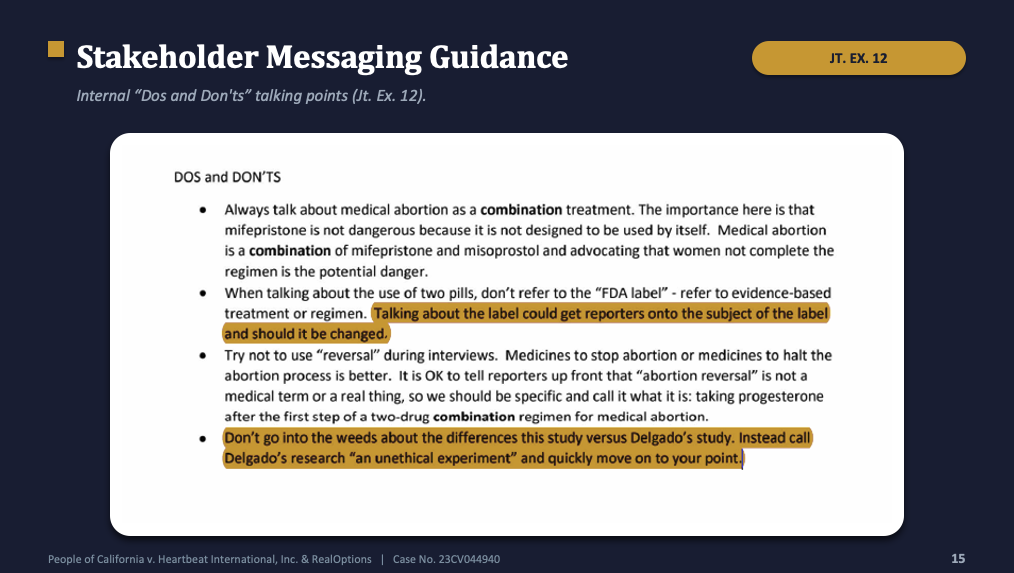
Dr. Creinin’s own trial showed continuing pregnancies in four of five women in the progesterone group, against only two of five in the placebo group—a result that’s consistent with other studies that have found APR effective. And when those results came in, Dr. Creinin—a paid consultant to Danco, the manufacturer of mifepristone—convened a private stakeholders’ meeting to craft messaging and talking points about how to frame the results of his failed study. The Court will see some of those talking points in Slide 15.
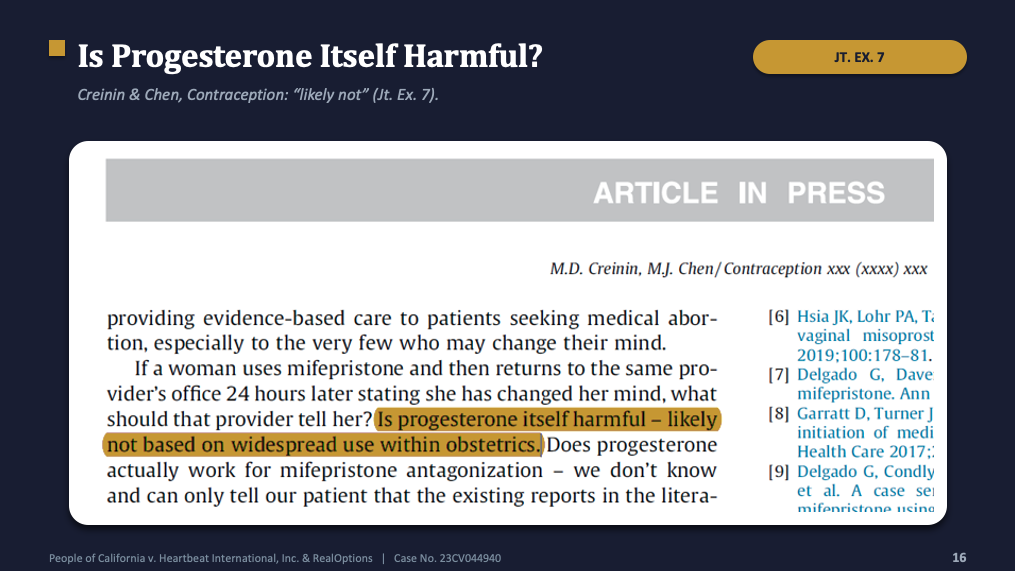
Tellingly, the Attorney General has himself retreated from the study he once leaned on. He’s admitted in discovery that the Creinin study does not establish that APR is unsafe. And in his own 2019 commentary—Slide 16—Dr. Creinin noted progesterone’s widespread, long-standing use in pregnancy and acknowledged that progesterone itself is likely not harmful. When the State’s own lead expert cannot say the treatment is unsafe, and cannot say it is ineffective, the State has not carried—and cannot carry—its burden of proving that Heartbeat International’s and RealOptions’ statements about safety and efficacy are false or misleading.
V. Even on the Merits, the Statements Are Not False
Your Honor, the third ground is the merits—and even if the Court assumes this is commercial speech and sets the burden question aside, the evidence will show the challenged statements are accurate, or at the very least reasonably grounded in science. A statement made in reasonable reliance on legitimate science is not actionable, even if a critic disagrees. I will address the challenged statements.
With respect to the overall issue of representing that APR is effective:
At the heart of the Attorney General’s theory of the case is the false proposition that the effectiveness of a treatment can only be proven through Randomized Controlled Trials (RCTs). That is not a consensus view in medicine. It is both too broad and too narrow. As this Court will hear from our experts, RCTs can yield what appear to be causal relationships that later research disproves. On the other hand, researchers and doctors have long recognized that other forms of evidence, taken together, can establish effectiveness to a reasonable degree of medical certainty.
To illustrate, the Court will learn that the State’s own expert on biostatistics, Dr. Glidden, regularly collaborates on studies that do not follow the RCT model, yet make efficacy claims. Indeed, Dr. Glidden concedes that historical controls—which our clients use—can be used to show causality. The Court will learn that Dr. Creinin believes that observational studies can justify the use of off-label treatments. The Court will hear that the overwhelming majority of ACOG’s recommendations are not based on RCTs.
As the Court will hear, where RCT evidence is absent, weak, or unethical, researchers use the Bradford-Hill criteria, which were established more than six decades ago. These criteria are used to evaluate whether a statistical correlation in observational data supports statements about effectiveness. The factors are: temporality, strength of association, consistency, biological gradient, plausibility, coherence, experiment, specificity, and analogy. These factors remain the baseline framework for much of medical research today, and we will show that they all support the claim that APR is safe and effective.
Temporality. A cause must precede an effect. This criterion is satisfied: APR administration precedes the observed outcome that a pregnancy continues.
Strength of association. Is there a robust statistical association between a cause and an outcome—here, between supplemental progesterone and mifepristone alone? This is an important factor, and it is one that we will take care to show Defendants easily meet. We can compare women who took a single 200-milligram dose of mifepristone without progesterone to women who have taken progesterone after mifepristone. The results are statistically significant, even when stratifying by gestational age.
Consistency. Is this result observed in different places, by different people, under different circumstances or study designs? As the Court will see, this factor is met. We will show that Delgado, Turner, Garratt, and even Creinin independently observed similar results in their studies.
Biological gradient. Does a different dose yield different results? This is also in APR’s favor. High-dose oral progesterone yielded a higher success rate than lower doses. More intramuscular shots yielded higher success rates than fewer shots.
Plausibility. Is the underlying theory of APR biologically plausible? We will show that experts on both sides agree on this point. Mifepristone works by blocking a receptor; it occupies the receptor progesterone would otherwise bind to. Dr. Kraus will testify that mifepristone is a reversible competitive inhibitor, and that supplemental progesterone in high enough concentration outcompetes it at that receptor. This is not a fringe position. The Court will read in Slide 17 the FDA’s own pharmacology review of mifepristone, which states the drug’s abortifacient activity is antagonized by progesterone, allowing for normal pregnancy and delivery. Although the FDA made this statement on the basis of animal studies, the results in animal studies support the plausibility of efficacy in humans. Indeed, we will show that the FDA will sometimes authorize the use of new drugs on the basis of animal studies alone.
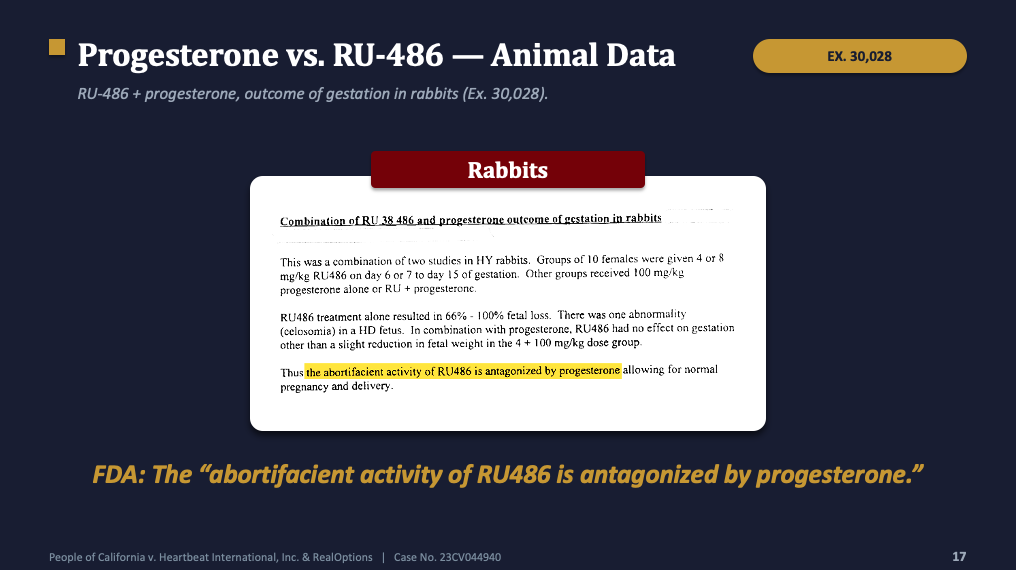
Coherence. Does the proposed treatment conflict with what is already known about the natural history and biology of the condition sought to be cured? We will show that it does not. From the very beginning, mifepristone researchers—including Baulieu, the inventor of the abortion pill—acknowledged that mifepristone binds to receptors reversibly, and enough progesterone could reverse its effects.
Experiment. Is there supporting experimental evidence? As I have discussed, there certainly is.
Specificity. Is the treatment linked to a specific outcome? Yes—APR is specifically linked to continuing pregnancy.
Analogy. Are there similar relationships or established causal links in other fields that can be used to support the hypothesis? Yes. We will show that there are many examples of competitive inhibition where an agonist outcompetes an antagonist. An important example our experts will discuss is DMPA, a progestin which has been proven to increase the surviving pregnancy rate after mifepristone and even misoprostol.
We will show that APR is demonstrated to work even without RCTs. Dr. Delgado will explain why in this context RCTs are ethically problematic and unnecessary. He compares it to CPR: a lifesaving maneuver that is now universally accepted. As he will say, if a person suffers a heart attack, you do not put him in a placebo group and withhold CPR. Once you discover CPR works, you do it on everybody. The same thing with APR—which is like CPR for a preborn baby. But the Court will hear through our experts that there is substantial scientific evidence backing it up.
Turning to the word at the heart of this case: “reversal.”
The Attorney General says it is false to call this a reversal. The evidence—through Defendants’ medical experts—will show why it is not. Defendants have evidence that APR works and that it works by competitive inhibition. The Court will hear that “reverse” is an accurate, ordinary-language description of what actually occurs. For example, Slide 18 shows the CDC and FDA using the exact same word—reverse—to describe how NARCAN, an opioid antagonist, can reverse the effects of opioids by competing for the same receptor sites. And where the weight of the science supports the characterization, it is a matter of scientific interpretation—which is opinion, not falsity.

The Court will hear even the State’s own expert, Dr. Creinin, agree with the biological plausibility of APR—and even concede that there is evidence supporting APR. But he insists on more RCTs in an area fraught with ethical peril, and even though he—supposedly a great research scientist—could not safely perform one.
You will hear Dr. Creinin demand a level of scientific certainty for APR that he admits is often not required in medicine, especially in the context of pregnancy. Dr. Creinin agrees that “the basis for patient care decisions should not be restricted to randomized trials,” especially for uncommon situations. You use the best scientific evidence available.
The Court will hear that “reverse” is an accurate, ordinary-language description of what actually occurs—and where the weight of the science supports the characterization, it is a matter of scientific interpretation, which is opinion, not falsity.
Next, the 64-to-68-percent success rate.
Here the Attorney General will tell the Court the evidence is no good. But the Court will see the actual body of evidence Defendants relied on, and it is substantial. The exhibits include the 2012 and 2018 Delgado studies, the 2017 Garratt and Turner study, the 2023 Turner single-arm trial, and even Dr. Creinin’s study. We also have the DeBeasi scoping review and the FDA materials—a whole series the Court will have before it. Our medical experts will explain what that evidence shows: that roughly two-thirds of women who receive progesterone after mifepristone continue their pregnancies, against a continuing-pregnancy rate of only 23 to 25 percent after mifepristone alone.
In fact, the evidence will show in Slide 19 that Dr. Creinin privately admitted his position that mifepristone alone most likely has a continuing-pregnancy rate of just 8 percent—far below the conservative estimate of 25 percent used in the studies we rely on.
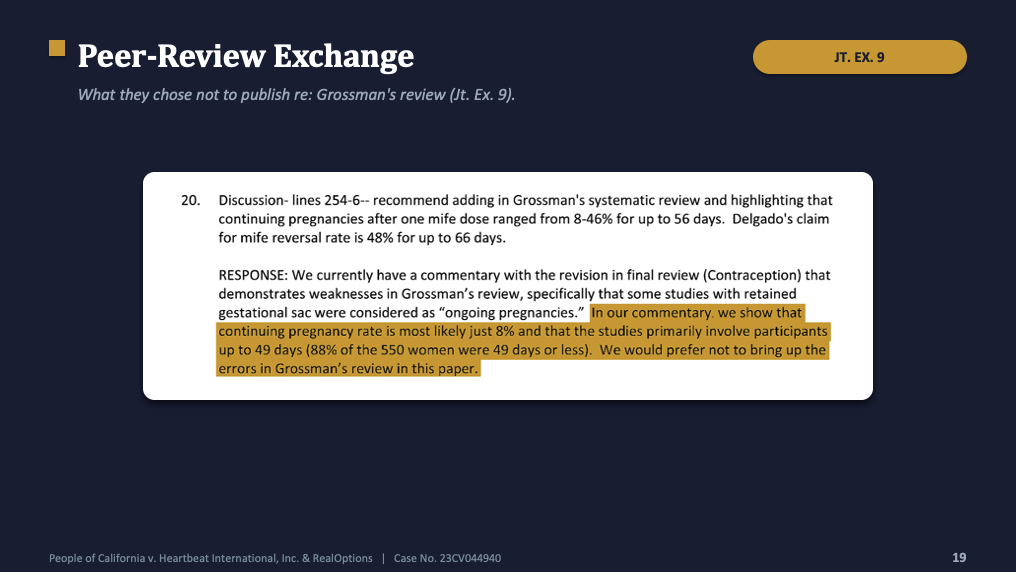
The Court will hear from Dr. New, our expert statistician, that the gap between the mifepristone-alone survival rate of 8 to 25 percent and the progesterone survival rate is far too large to attribute to chance.
Again, the specific figures—64 to 68 percent—come directly from the 2018 Delgado study, and the exhibits will show Defendants did not overstate them: they expressly caveated that the rate comes from “initial studies.”
Your Honor, just today the People showed the Court Joint Trial Exhibit 27—the document that explains the success rates of Abortion Pill Reversal. They selectively quoted the fact that it mentions the 64-to-68-percent success rate, but they failed to note what the document says right underneath it: that without the APR treatment, mifepristone may fail to abort the pregnancy on its own—in other words, the pregnancy may continue even without the APR protocol if the client does not take misoprostol. The document continues to say the outcome of each particular reversal attempt cannot be guaranteed, that the client is encouraged to follow all of the instructions of their APR Network provider carefully, and the document also very clearly states that this figure is based on initial studies. There is ongoing research in this area—and, in fact, just today a study was published in another peer-reviewed journal concerning APR.
The Attorney General complains that our clients do not break down all the percentages for the different protocols. But Heartbeat International will explain that it helps to think of these like 911 calls. The purpose is to quickly connect a woman with care because she took a pill that is designed to kill the baby she now very much wants to carry to term. The overwhelming majority of women receive the oral route with the higher success rates, so this is the most relevant information for the overwhelming majority of their callers.
The Attorney General’s complaint is that he finds the Delgado study unreliable. But the Court will hear about the study’s numerous strengths. It is very large, especially in the context of OB-GYN care, and even more so in the context of abortion and APR specifically. Even the subgroups looking specifically at intramuscular and high-dose oral were larger than the active arm in Dr. Creinin’s study. It has a large variety of treatment methods and sources of treatment. We will show that the Attorney General’s criticisms amount to speculation—that ultrasounds might have thrown off the results, that women who called the study but did not initiate treatment might have had more bleeding. The rest of the Attorney General’s criticisms about the prestige of the journal and republication do not affect whether the data was reported reliably and whether the data can be used. In addition, the evidence will show that our clients did not rely on the Delgado study in a vacuum, but rather in light of all the evidence they already knew about APR and have since acquired.
So the legal question is not whether the Attorney General would have designed the study differently—it is whether Defendants acted with reasonable care in relying on it. The evidence will show that Defendants were perfectly justified in truthfully restating the results of this peer-reviewed study.
Perhaps most interestingly on this point: the evidence will actually show that Dr. Creinin privately believes the 2018 Delgado study qualifies as substantial evidence. It will be impossible for him to square his current opinions with those he put in writing years before this case was filed.
In fact, the Court will hear that our clients track and maintain internal data for their APR referrals and patients—and that their success rates match up with the published literature when a viable pregnancy is confirmed. None of the Attorney General’s experts analyzed that data before we deposed them. In the case of RealOptions, their most recent data now show a 68-percent effective rate with only one person lost to follow-up.
For Heartbeat International, the Attorney General’s position is that loss to follow-up justifies categorically disregarding a massive volume of data. We will explain why that is mistaken and unreasonable. Even imperfect or incomplete data has scientific value.
As far as RealOptions’ data: the Attorney General showed People’s Exhibit 20042, where Tasha Keirns discusses a low success rate and states that is not a good number to share. Unfortunately for the Attorney General, the evidence will show that their interpretation is false. Ms. Keirns will testify that at the time of the 2021 email, she was the newly appointed Director of Nursing and discovered a previous Director had left patient data incomplete: many patients were lost to contact and there were gaps of basic information. She was concerned the 35-percent success rate would not accurately reflect the true success of APR. After that email exchange, Ms. Keirns reviewed each chart and contacted patients that were lost to follow-up to ensure the data was complete and accurate. RealOptions determined that 35 percent was significantly lower than their true success rate once all the data was confirmed and calculated. So this evidence will actually show that RealOptions took data collection and analysis seriously and wanted to ensure its representations to the public were as accurate as possible.
Turning to the conditional statements—the “may” statements.
The Attorney General challenges statements that reversal “may” still work after 72 hours, and that progesterone “may” help support a pregnancy after mifepristone or methotrexate. That one word controls. The exhibits will show these are conditional advisements—that it may not be too late, that a woman may still ask for a referral. To prove a conditional statement false, the Attorney General would have to prove the condition could never be satisfied. The evidence will cut the other way. The Court will hear from Dr. Davenport and Dr. Delgado that a substantial portion of mifepristone remains in the body past 72 hours—and the Mifeprex label itself, an exhibit in this case, states that mifepristone is only about 50 percent eliminated between 12 and 72 hours. Heartbeat International’s own outcome data, through Mr. Godsey and Ms. Brown, will show documented reversals in that window.
In fact, the evidence will show that even Dr. Creinin believed that mifepristone could lead to fetal demise up to two weeks after ingestion—demonstrating the potential of supplemental progesterone to support a pregnancy after 72 hours.
The State’s only path forward on these statements is to argue that they are misleading. So the State points to the absence of a formal study. But the evidence will show Defendants expressly disclose that no such study exists and leave the decision to the women.
As far as the statement about birth defects: the evidence will show that Dr. Creinin admitted under oath that neither mifepristone nor progesterone is known to cause birth defects. And the weight of evidence will demonstrate that APR does not increase the risk of birth defects.
Heartbeat International’s statement about thousands of lives saved is backed by the more than one thousand confirmed births reflected in our client’s internal data. The evidence will also show—and our experts agree—that Heartbeat International can support this statement using the projection of the 64-percent success rate on the women that they have been in contact with for at least two weeks after APR—which is the same window Dr. Creinin chose in his 2020 study, which he believed was sufficient to determine if mifepristone had an effect on the pregnancy.
As far as the challenged statements and RealOptions specifically: the claims against RealOptions rise and fall with everything I have just previewed. The evidence will show its website uses Heartbeat International’s model FAQs—the same “reversal,” “effective,” and success-rate statements—which are not false for the same reasons.
Turning to the consent forms and side effects:
The Court will have the chance to actually read Heartbeat International’s and RealOptions’ detailed consent forms and hear from their witnesses about what they tell women who are about to start APR. The Court will hear from Tasha Keirns at RealOptions that they do not represent that side effects are only minor; they list the side effects for which there is evidence, and they direct women to seek emergency care if they experience heavy bleeding as a result of taking mifepristone. The evidence will show that their consent forms are detailed and robust.
The same is true for Heartbeat International. The Court will hear, by designation, Heartbeat International’s own hotline nurse, Lisa Searle, describe that she tells women to seek emergency medical attention for heavy bleeding, faintness, severe pain, or fever. That is affirmative safety counseling, not concealment.
So, to put this evidence into context: even if every one of these statements were commercial speech, the Attorney General still must prove three things—likelihood of deception, material misrepresentation, and intent to deceive. The evidence will show the opposite: Defendants relied on a deep body of peer-reviewed science and on credentialed physicians, and they actually believe what they say.
VI. Constitutional Defenses
Your Honor, the fourth ground is constitutional, and even if the Court found a violation on the statutory merits questions, three independent defenses remain in this case—free speech, free exercise, and reproductive privacy—and the evidence supports each. I will not cover them at length this morning.
First, and most important: at best, this is speech about disputed science, and the State is punishing one side of it based on content. Just this year, in Chiles v. Salazar, the U.S. Supreme Court reaffirmed that content-based censorship of professional medical speech, justified by an asserted “medical consensus,” triggers the most demanding scrutiny—because majority medical opinions evolve, and licensed professionals have good-faith disagreements about practice in their field. That is this case exactly. There is a good-faith scientific debate. And in that regard, the evidence will show that multiple professional medical associations support APR, including the American Association of Pro-Life Obstetricians and Gynecologists, the Catholic Medical Association, the American College of Pediatricians, and the Christian Medical & Dental Associations. These groups represent tens of thousands of physicians and healthcare professionals across the country.
The State initially relied on a professional society fact sheet from ACOG which declares APR as unsupported by science. But the Court will hear, by designation, that ACOG’s own corporate witness, Dr. Zahn, confirmed the document is labeled simply as an “Advocacy Statement,” that it rests on the same critic the State relies on here—Dr. Creinin—and that it claimed the APR studies had no control group and no safety data when the leading study had both.
The Attorney General is free to take one side of this debate and say so publicly. We will show that he is seeking to impose crippling sanctions and penalties to silence the other side.
We now know that the State has suddenly disavowed any reliance on ACOG—and the evidence will show why. The Court will hear Dr. Zahn concede that ACOG has not actually formally made and published any graded recommendation regarding Abortion Pill Reversal treatment, either for or against. ACOG admits that a single case study qualifies as Level III evidence. And it is not ACOG’s position that it is dangerous to take progesterone after mifepristone in order to reverse the effects of mifepristone.
Second, the First Amendment does not permit the State to punish “falsity alone,” untethered from any real-world harm. And here the Attorney General admits—in his own discovery responses—that he has no evidence of any complaint from any APR patient, and no evidence that APR has harmed anyone. No injury. The constitutional guarantee requires breathing room for protected speech, and punishing speech that has harmed no one is the opposite of breathing room. The same absence of harm means the Attorney General cannot satisfy intermediate scrutiny either—he has no evidence the harms he recites are real, and a public-information campaign stating his own view of APR would be an obvious, less-restrictive alternative to silencing Defendants. And APR itself remains perfectly legal in California, which alone makes censoring truthful speech about it constitutionally suspect.
Third, free exercise—and this is a defense that remains squarely before the Court. Defendants’ APR work is religiously motivated. Under the California Constitution, a substantial burden on that religious exercise triggers strict scrutiny outright. And under the federal Constitution, strict scrutiny applies wherever the law is not neutral and not generally applicable. Both routes are open here. The Attorney General concedes he cannot meet strict scrutiny.
As we explain in our trial brief, the FAL and UCL are neither neutral nor generally applicable on their face under the Free Exercise Clause because they exempt public entities. But even if they were, the enforcement itself is not neutral. The State has trained its consumer-fraud power on religiously motivated, pro-life speakers while declining to bring any comparable action against abortion providers who make their own contestable claims about mifepristone—including, on this record, that the abortion pill is safer than common over-the-counter medication. Ironically, the Attorney General makes that claim in his complaint—and his own expert declines to endorse it.
That pattern—burdening religiously motivated conduct while permitting comparable secular conduct that undercuts the same asserted interest—is precisely what numerous controlling cases hold triggers strict scrutiny. The evidence of the State’s post-Dobbs targeting of these organizations is properly before the Court on this defense. Since this evidence is subject to a pending request for judicial notice, I will address them later in the course of the trial.
And fourth—with no small irony—California’s own reproductive-privacy guarantees protect a woman’s decision to continue a wanted pregnancy. The Reproductive Privacy Act shields those who aid or assist a pregnant person in exercising that right. Cutting off information about APR interferes with exactly that decision. The State’s action collides with the very privacy protections it elsewhere champions.
Any one of these is independently sufficient, and the Attorney General concedes that he will not and cannot attempt to satisfy the strict scrutiny that they demand.
The irony is that the evidence will show that the Attorney General, who claims to be in favor of a woman’s right to choose, is prosecuting a case that seeks to strip women of their choice—made in consultation with their doctors—to safely continue their pregnancies after taking mifepristone.
The Court will also hear, unfortunately, that a large percentage of women who start a medication abortion are under pressure from family and friends, some of them are sex-trafficked or coerced, and many have financial difficulties that lead them to believe abortion is their only option. The evidence will show that when they call Heartbeat International and RealOptions, they have already considered withdrawing consent for proceeding with the medication abortion, and they are looking for information about how to save their unborn child.
The evidence will show, ironically, that the misinformation is actually flowing in the opposite direction. Abortion-minded women are being told by their abortion providers that if they attempt to reverse their abortion, they will become seriously injured, that their babies are already dead, or that they will be born extremely deformed. The evidence will show that Heartbeat International and RealOptions correct this by truthfully telling women that they are not at an elevated risk of birth defects and that APR is safe and effective.
VII. Penalties, If the Court Ever Reaches Them
Your Honor, I raise penalties only for completeness, because the Court should not reach them at all. There is no violation here, and no remedy is needed.
But if the Court did reach the question, the numbers the State asks for tell you something about this case. The Attorney General seeks nearly $20 million from Heartbeat International and another $640,000 from RealOptions—enough to drive them into bankruptcy—for offering a free service that has harmed no one and that no one has ever complained about. And consider how he builds that number: he counts each woman who contacted these Defendants as a separate violation—treating every act of helping a frightened woman as a discrete fraud. The penalty factors the statute directs the Court to weigh are the seriousness of the conduct, its willfulness, the number of violations, and—critically—the defendant’s monetary gain. Here the monetary gain from APR is zero. The conduct is charitable and religiously motivated. And the harm is nonexistent.
Amazingly, the State seeks damages for every woman who began APR treatment—even those who experienced a successful reversal and today are happily holding their healthy children born after APR, like the seven mothers who will testify in this case.
There are also hard legal limits on the State’s tally. The statute of limitations bars any violation before September 21, 2020. And the False Advertising Law does not reach out-of-state conduct, so Heartbeat International cannot be penalized for referrals outside California. When those are applied, the State’s headline number collapses.
The evidence will also show that the Attorney General appears to have double- and triple-counted some women based on the information they believe she received—counting them twice if they received supposed “misinformation” about mifepristone and misoprostol.
The evidence will show that the Attorney General has said this case is not about banning APR—it is about false speech. But we will establish that the crippling fines he seeks will have the effect of shutting down these wonderful organizations and thus banning APR—something he likely knows.
So, if the Court ever reaches penalties—and it should not—any penalty would have to be de minimis. A twenty-million-dollar fine for free, harmless, charitable speech would not be a remedy. It would be a punishment for holding a disfavored view.
Ultimately, these disfavored pro-life views are not relevant to the Attorney General’s claims. This is not a case about whether abortion is good or bad; it is a case about whether women should be able to access information about APR. Ironically, it is about a woman’s right to choose.
The reality is that this case has life-and-death implications. If the Attorney General prevails and our clients cannot deliver free, truthful, and lifesaving information to women who request it, then countless babies that could survive may not—and countless women may never meet the children that they wanted to carry to term. The consequences are profound.
The Attorney General showed the Court a slide referencing three cases involving APR to suggest that Heartbeat International knew or should have known its statements are deceptive. But they cannot cherry-pick case citations to make it seem as though this is settled judicially.
First, the State’s three cited cases were about forced speech. They do not support the State’s own attempt to censor speech reflecting good-faith scientific findings about APR. These three inapplicable cases merely confirm there are competing views of the science about APR. The views of three individual judges versus those of hundreds of legislators nationwide does not mean the science is settled.
The State ignores judicial confirmation that APR’s efficacy is a matter of ongoing scientific dispute. In Bella Health and Wellness v. Weiser (D. Colo. 2025), the court noted the “substantial scientific debate on how effective progesterone treatment is for at least some of its off-label uses,” acknowledging that the parties and their experts hotly contest APR’s efficacy. And in National Institute for Family and Life Advocates v. James (W.D.N.Y. 2024), the court similarly recognized the ongoing debate and held that the State cannot engage in content-based discrimination to advance its own side of that debate. That court further noted that the State conceded no one has ever been harmed by the plaintiffs’ statements, and that even assuming progesterone treatments present a risk of harm, the treatment can only be obtained through a prescription from a doctor—so the speech would, at most, encourage a woman to speak with her doctor. There are a number of other cases the Attorney General neglected to mention to this Court.
VIII. Conclusion
Your Honor, let me close where I began.
This case asks whether the State can punish truthful information about a free service as commercial fraud. By the end of this trial, the evidence will show that it cannot—for reason after independent reason.
The speech is not commercial, so the statutes do not apply. Even if they did, the Attorney General cannot carry his burden of proving falsity—he has criticism, not proof. Even on the merits, the statements are accurate and grounded in legitimate science. And even past all of that, this speech is protected by the freedoms of speech and religion and by the right to reproductive privacy.
And running underneath every one of those grounds is the same stubborn fact: despite eighteen years of APR in California, after years of investigation and discovery, the State has not produced one injured woman. Not one complaint. Only mothers who are glad they were given information—and glad they could choose.
At the close of the evidence, we will ask the Court to find that Defendants’ speech is noncommercial; that the State failed to prove it false; that it is in any event constitutionally protected; and that these Defendants are not liable.
Thank you, Your Honor.


